Hard water is costing you more than you think.
The Water Truck LLC installs, services, and maintains water softeners, reverse osmosis, filters and conditioners.


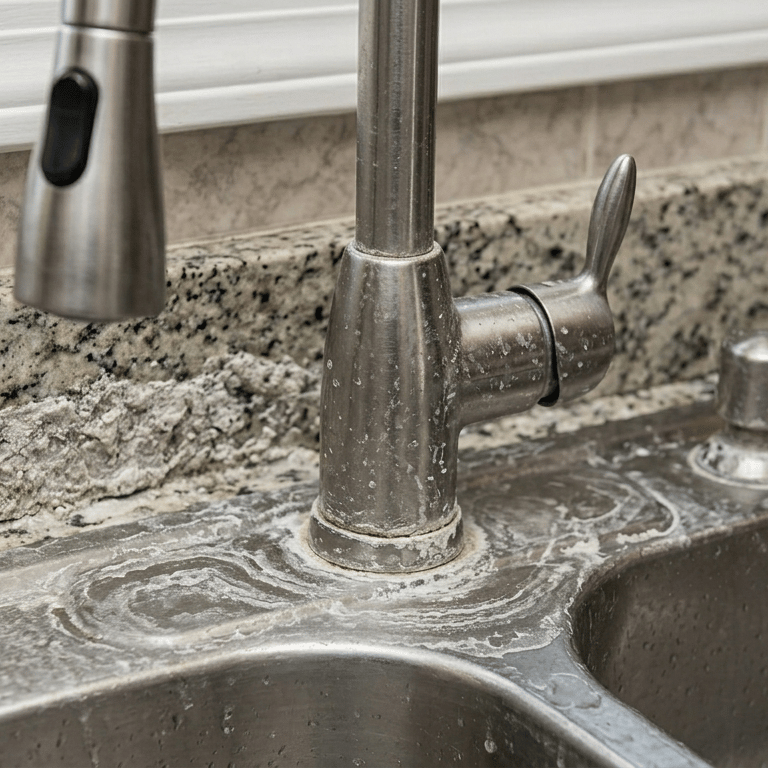
Scale builds up before you notice the damage.
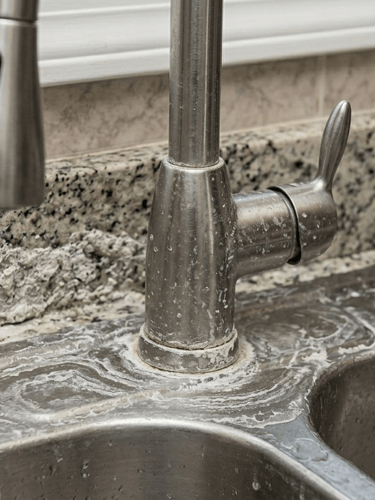
Minerals in hard water coat pipes, water heaters, and fixtures over time—cutting appliance lifespan, raising energy bills, and leaving stains no cleaner fully removes.
A properly sized and installed softener stops the buildup at the source. We'll tell you your water's hardness level and what that means for your home before you buy anything.
Water Heaters
Fixtures & Faucets
Skin & Laundry
Hard water scale forces water heaters to work harder—cutting efficiency by up to 30% and shaving years off the unit's life.
Calcium deposits clog aerators, stain sinks, and corrode valve seats. Once the pitting starts, the fixture doesn't recover.
Hard water leaves soap residue on skin and fabric. Clothes fade faster; skin stays dry even after a full rinse.
Install. Service. Replace.
Water softeners, RO systems, conditioners, and replacement filters—sized for your home, installed by our crew, maintained for the long run.
New Install & Systems
Service & Filter Replacement
Softeners, conditioners, and RO systems.
Annual service calls, salt delivery, and scheduled filter swaps.
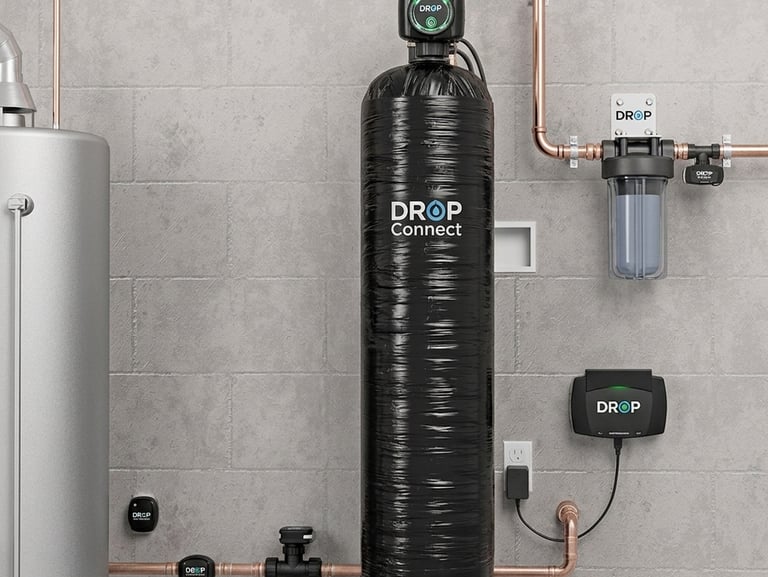
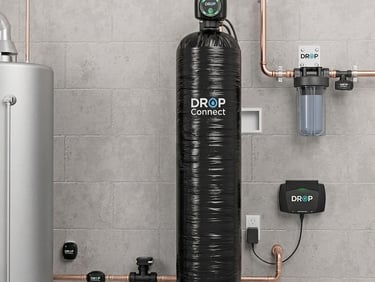
The DROP Hub
This advanced smart hub serves as the central control system for the DROP smart water management platform. It seamlessly connects and manages your home's water treatment devices.



Water Stats
The average family can waste 180 gallons per week, or 9,400 gallons of water annually, from household leaks. That's equivalent to the amount of water needed to wash more than 300 loads of laundry.
Household leaks can waste approximately nearly 900 billion gallons of water annually nationwide. That's equal to the annual household water use of nearly 11 million homes.
Running the dishwasher only when it's full can eliminate one load of dishes per week and save the average family nearly 320 gallons of water annually.
Turning off the tap while brushing your teeth can save 8 gallons of water per day and, while shaving, can save 10 gallons of water per shave. Assuming you brush your teeth twice daily and shave 5 times per week, you could save nearly 5,700 gallons per year.
Letting your faucet run for five minutes while washing dishes can waste 10 gallons of water and uses enough energy to power a 60-watt light bulb for 18 hours.
Outdoor water use accounts for more than 30 percent of total household water use, on average, but can be as much as 60 percent of total household water use in arid regions.
If the average sized lawn in the United States is watered for 20 minutes every day for 7 days, it’s like running the shower constantly for 4 days or taking more than 800 showers. That's equivalent to the amount of water needed for the average family to take 1 year's worth of showers.
As much as 50 percent of the water we use outdoors is lost due to wind, evaporation, and runoff caused by inefficient irrigation methods and systems. A household with an automatic landscape irrigation system that isn't properly maintained and operated can waste up to 25,000 gallons of water annually.
When hiring a professional to install or audit your landscape irrigation system, be sure he or she is certified by a WaterSense labeled irrigation program. If the system is well managed, a household's irrigation water use can be reduced by 15 percent, or nearly 7,600 gallons of water, annually. That's the amount of water needed to take 480 showers.
* Other data and information used by WaterSense is available . Please contact the WaterSense Helpline at watersense@epa.gov or (866) WTR-SENS (987-7367)
Proactive Home Protection: How Automatic Water Shut-Off Valves Are Reshaping Property Safety
When homeowners consider property risks, major weather events often dominate the conversation. However, public data reveals that the most frequent and costly threat to a home is much closer to home: its own internal plumbing. Non-weather-related water damage—such as burst pipes, appliance leaks, and failing fixtures—accounts for more than $13 billion in annual losses across the United States.
To combat this, homeowners and insurers are moving away from reactive cleanup and adopting a highly effective preventative technology: the automatic water shut-off valve.
The Public Data: Why Early Detection Matters
The physical scale of water damage is a direct function of time. A standard pipe burst can release up to 480 gallons of water per hour—enough to completely flood a basement or ruin multiple floors of a home in a single workday.
Insurance industry studies highlight a dramatic shift in property protection when smart technology is introduced:
Claim Frequency and Severity: A comprehensive 2026 study analyzing properties equipped with smart water monitoring and automatic shut-off devices found an 81% drop in claim frequency and an 85% reduction in claim severity after installation (Claims Pages, 2026).
The Power of In-Line Mitigation: Independent research by LexisNexis Risk Solutions revealed that whole-home, in-line water shut-off systems correlate with a 96% decrease in water claim events compared to homes without any protection, which actually saw a 10% increase in claims over the same timeframe.
Wasted Resources: Beyond property protection, environmental data from the EPA shows that household leaks waste nearly 900 billion gallons of water nationwide each year.
To evaluate how an upfront investment in prevention compares to the potential costs of a major plumbing failure, you can use the financial projection tool below:
Insurance Incentive: Because these devices drastically limit risk, major insurance carriers frequently offer premium credits or policy discounts ranging from 5% to 10% off homeowners insurance costs upon proof of installation.
How Automatic Shut-Off Systems Function
An automatic water shut-off valve operates as a continuous, automated gatekeeper for a home's entire plumbing infrastructure. Unlike passive moisture sensors that only detect localized water on a floor, an in-line system monitors the primary water supply line.
Continuous Monitoring: The device uses ultrasonic or mechanical flow meters to measure water consumption, pressure variations, and ambient temperature in real time.
Anomaly Detection: The system establishes a baseline of normal household water usage. If water flows uninterrupted for an abnormal period (e.g., 30 minutes of continuous high flow), or if pressure drops sharply, the system identifies it as a critical failure.
Mechanical Intervention: The unit instantly triggers an internal motorized ball valve, cutting off the main water supply to the house within seconds. Simultaneously, it sends an alert to the homeowner's smartphone via cellular or Wi-Fi networks.
By eliminating the need for human intervention during a plumbing failure, this technology ensures that a cracked pipe or ruptured washing machine hose results in a minor inconvenience rather than a catastrophic structural loss.
References
Claims Pages. (2026). Smart Water Shutoff Devices Cut Claim Frequency by 81%, Study Finds.
LexisNexis Risk Solutions. (2020). New Loss Correlation Study Reveals Use of In-Line Water Shutoff Reduces Escape-of-Water Home Insurance Claims by 96%.
Environmental Protection Agency (EPA). (n.d.). Fix a Leak Week: WaterSense.